



- Blogs /
- Masters by research In UK with dependent
Masters by research (MRes) in UK with dependent
Learn everything about the Master of Research (MRes) Degree in the UK, and what it has to offer, its requirements, and much more.

 11 months ago
What is masters by research degree and why study it?
If students value a course that offers an independent research opportunity and also teaches principles and techniques of research, a master of research degree (MRes from now on) in the UK is just for them. Students should study this course not only to increase their research skills, but also for:
- Amazing tools for research: MRes teaches principles and techniques for research crucial to a variety of industries, not just for scholars.
- Students have the flexibility to choose their duration, which is typically 1 to 2 years.
And without further ado, let's thoroughly understand everything about the MRes degree in the UK. P.S. Also learn about scholarships for international students in the UK.
What are the requirements of MRes degree?
Let's completely dissect the requirements of the MRes degree:
Academic qualifications requirements
Generally, students studying the MRes degree must have at least 2:1 (60-70%) in a degree from a recognised university specialising in a related subject.
English language requirement
Generally, students studying the MRes degree must get at least:
Documents checklist:
- Academic Transcript and reference (SEE, +2, bachelor's degrees, etc.),
- Resume/Curriculum Vitae (CV),
- Research proposal in your respective field,
- Statement of purpose (SOP),
- Marriage document, if applicable,
- Child's birth certificate, if applicable,
- Others per course.
What is the cost of studying MRes degree?
Generally, the cost of studying an MRes degree is around £15,000 to £30,000 per year, depending on the courses, university, and city of the student's choice.
What are the scholarships for studying MRes degree?
Let's understand some of the scholarships for studying for an MRes degree:
- Imperial College London Scholarships,
- University of Birmingham Scholarships,
- University College London Scholarships,
- University of Oxford Scholarships,
- Northumbria University Scholarships,
- Coventry University Scholarships,
- Chevening Scholarships,
- Commonwealth Scholarships,
- GREAT Scholarships, etc.
Are dependents allowed while studying MRes degree?
Yes, students are allowed to bring their dependents to the UK while pursuing the MRes degree. Dependents such as:
Partner
Students are allowed to bring their partner. They are even allowed to work if the course lasts longer than 9 months. Of course, other limits apply.
Children
Students are also allowed to bring children aged between 5 and 16 years.
Note: Bringing dependent(s) will increase the costs for the MRes degree. Additional costs depend on where you intend to study in the UK. Generally, additional costs include:
- Visa fees (roughly £490),
- NHS surcharge (roughly £1,035), and
- Living fund (roughly £680/month if intending to live in London, or £540/£680 if intending to live outside London).
Are students allowed to work while studying MRes degree?
Yes, students are allowed to work while studying the MRes degree, but some restrictions apply. According to the UK government, such restrictions include:
- Any student pursuing education must not exceed 20 hours of work per week.
- Students cannot be self-employed individuals, engaged in any business-related activity, professional athletes, entertainers, or full-time workers in any field.
- Students can work full-time during holidays, depending on the university or organisation.
- Students can work full-time as an apprentice in their field of choice.
What are the popular universities that teach MRes degree?
Some of the popular universities that teach the MRes degree are:
What are the popular courses for MRes degree?
Some of the most popular courses for the MRes degree are:
- STEM (Science, Technology, Engineering, and Mathematics)
- Social sciences
- Business research
- And many more.
What are the admission process of MRes degree?
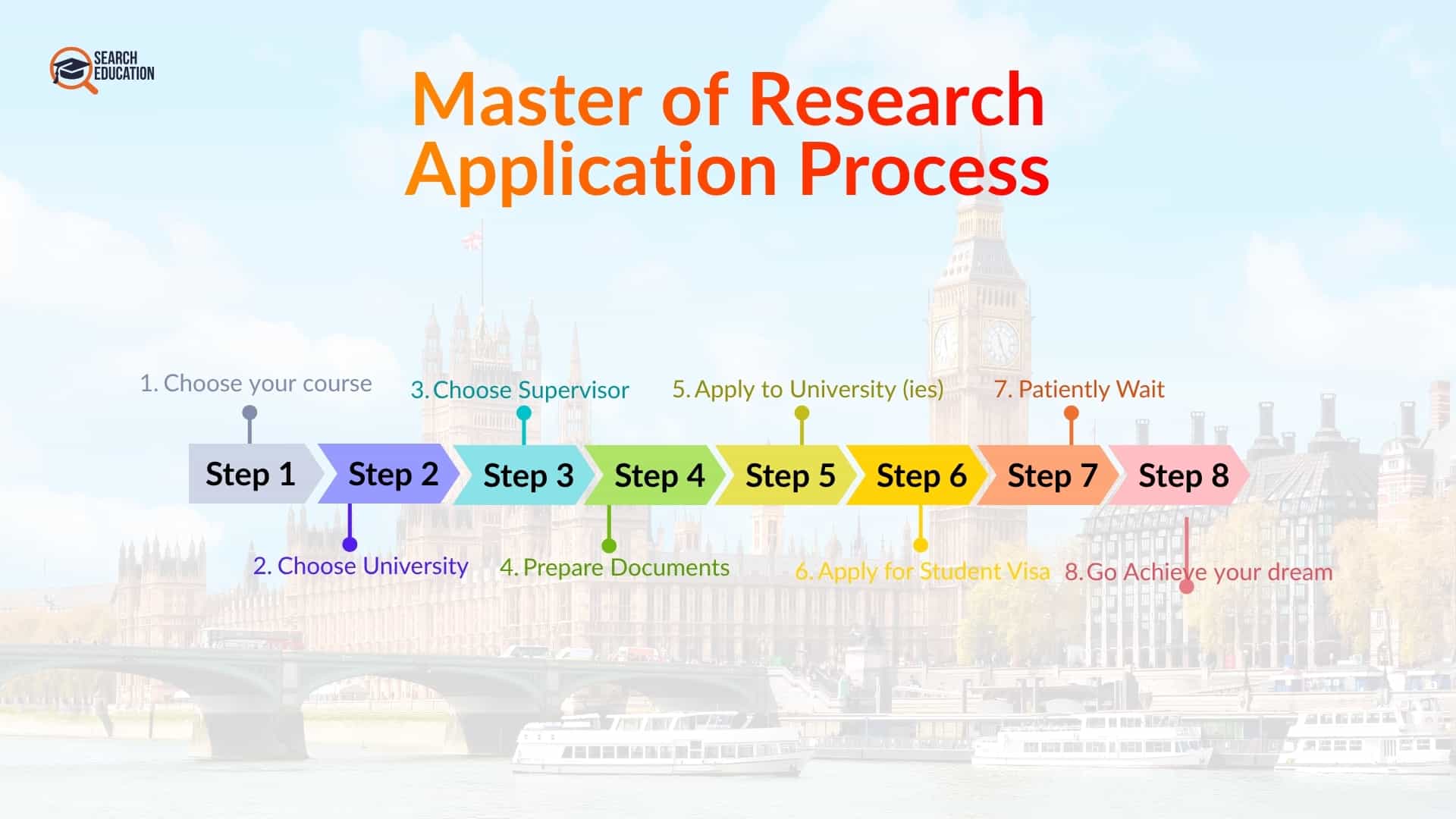
Let's thoroughly understand the step-by-step admission processforf the MRes degree:
Step 1: Choose your dream course.
First and foremost, research your preferred MRes degree field. You should look for answers to questions such as:
- What course do you wish to study?
- What field in that course?
- What branch of that field?
- What subject do you wish to research? Etc.
Step 2: Research and choose your university
After that, research universities that offer the MRes degree. Choosing multiple universities is better because you can choose one that offers the most value to you. When looking for universities, you should ask questions, such as:
- How well-known are they? Their ranking on the world stage?
- How strong is their research department?
- How strong, in terms of qualifications and experience, is their supervisor?
- What does the funding for research look like?
- Are there any scholarship opportunities? Etc.
Step 3: After choosing your universities, the next thing is choosing your supervisor.
They will not only guide you toward your field but also provide their in-depth experience and knowledge.
You should contact them via email and provide them with documents, including but not limited to:
- Resume/CV,
- Strong Research Proposal,
- Strong willingness to learn, etc.
Step 4: Document requirements, such as:
- Academic Transcript and references (SEE, +2, bachelor's degrees, etc.),
- Resume/Curriculum Vitae (CV),
- Research proposal in your respective field,
- Statement of purpose (SOP),
- Marriage document, if applicable,
- Child's birth certificate, if applicable.
Step 5: Apply to the university of your choosing and receive their reply.
Go to the respective universities’ sites and apply for admission for an MRes degree.
- Imperial College London Admissions,
- University of Birmingham Admissions,
- University College London Admissions,
- University of Oxford Admissions,
- Northumbria University Admissions,
- Coventry University Admissions,
- Others as necessary.
Even if you get rejected by one university, applying to multiple should help you choose one that hasn’t turned you down.
Step 6: Apply for a student visa to the UK.
You can apply for a student visa to the UK. You can also apply for a dependency visa for your partner and children, if applicable.
Step 7: Wait for your visa decision. At the same time, prepare your checklist for your departure and arrival in the UK.
Step 8: If your visa decision is OK, leave for the UK. Good Luck.
Final Thoughts: Should MRes degree be pursued by Nepali students?
If you're interested in conducting independent research, developing advanced research skills, and preparing for a future in academia or research-focused careers, an MRes (Master of Research) could be the right choice.
If you're planning to study an MRes in the UK, follow these simple steps:
- Consult with Search Education on the 3rd Floor of Bandipur Building, Putalisadak, Kathmandu. With over 10 years of experience in UK education counselling, our expert team will guide you through MRes entry requirements, university selection, costs, scholarships, and the application process.
- Follow our counsellors' guidance to prepare your documents and meet the admission requirements.
- Apply to your chosen MRes programme with confidence, knowing you've received expert support every step of the way.
Start your journey to studying an MRes in the UK. Contact Search Education today for personalized guidance and a hassle-free application process.
Leave a Comment
Related Post



Ready to Start Your Study Abroad Journey?
Book a Free Consultation with our expert counselors

Frequently Asked Questions?
What can a Nepali student do with MRes degree from the UK?
It depends on factors including but not limited to the field, whether you intend to stay and work in the UK, and the demand for the field.
What is the timeline of a MRes degree in the UK? How long will it take to complete?
It depends on your choice and the scope of the research proposal. But mostly, it takes around 1 to 2 years to complete.
Can you work in the UK while pursuing MRes degree?
Yes and no. It depends. You are allowed to work up to 20 hours every week on a student visa. For more info, go to the UK government website.
How much does a MRes degree in the UK cost?
It depends on factors such as the university, the field, accommodation, and various other factors. But normally, it hovers around £15,000 to £30,000.
Do you Nepali students need to take an English proficiency test to study MRes degree in the UK?
After completion of the MRes degree in the UK, is it valid in Nepal?
Yes, it is valid in Nepal, assuming you have completed the MRes degree from a recognised university.
Is a MRes degree in the UK regarded the same as a PhD?
No, a PhD is different from a master’s course. A PhD is something you do after your master's degree.
Are dependents allowed while pursing MRes degree in the UK?
Yes, the UK government allows you to bring your spouse(partner) and your child between the ages of 5 and 16.